Shopping Cart



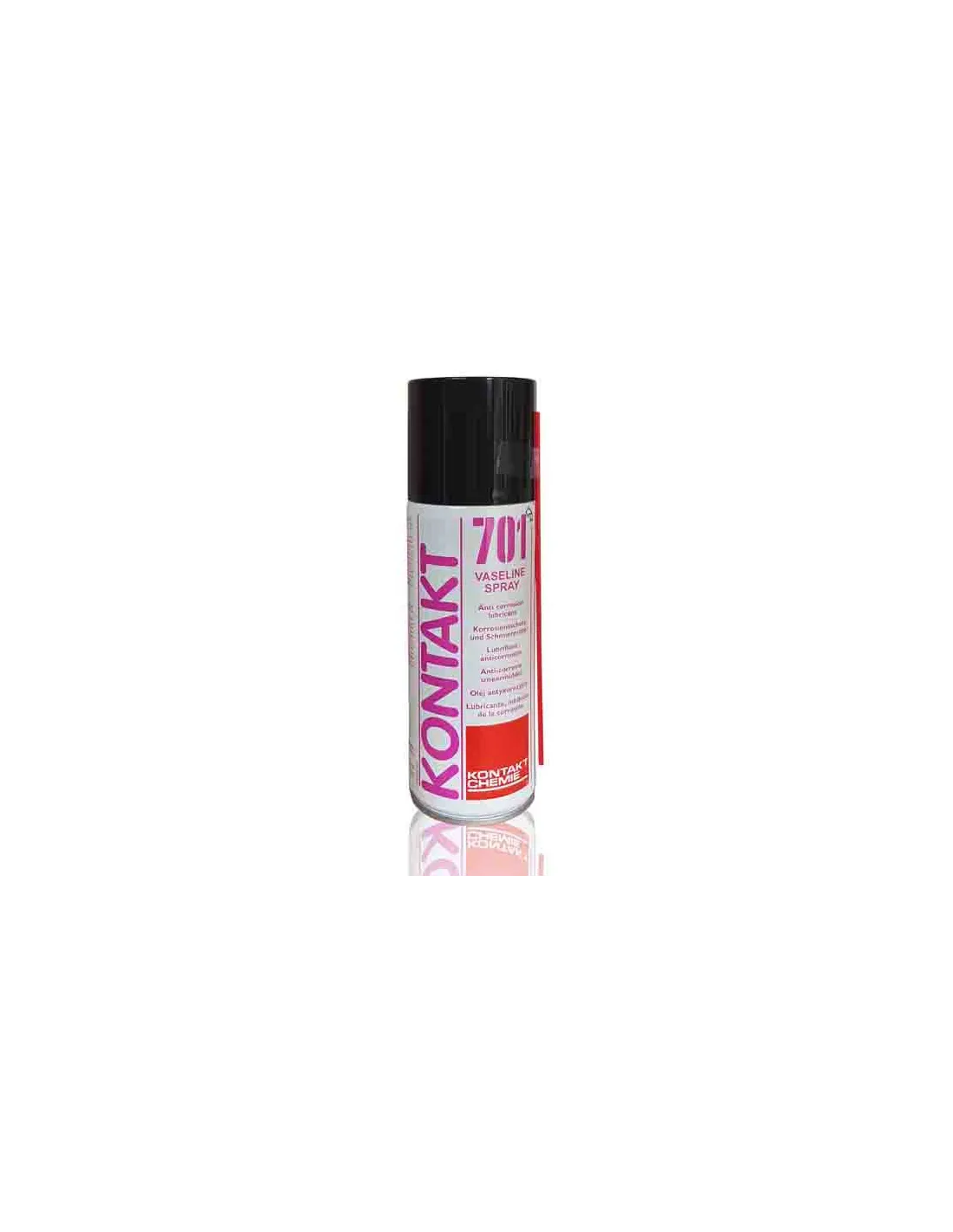
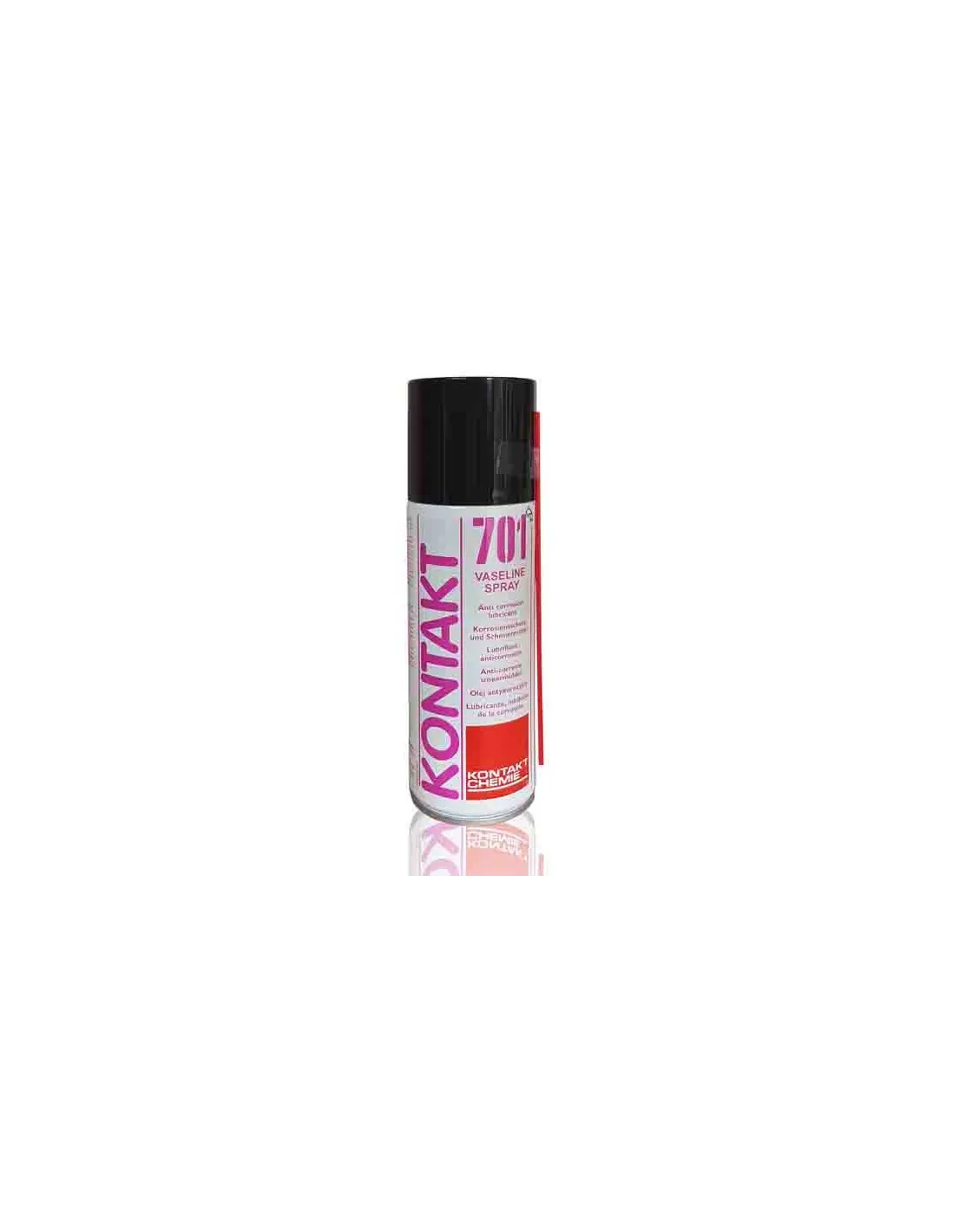
KONTAKT 701 -Spray Vaseline-
205001000
€15.00
18,15 € Tax incl.
18,15 € Tax incl.
This product cannot be shipped by air. To the Balearic Islands it is sent by sea freight. For deliveries to the Canary Islands, please contact us before ordering.
Pure petroleum jelly spray (200 ml). Release agent, lubricant and anti-corrosive compatible with metals, rubbers, wood and synthetic materials.
KONTAKT 701 is a pure petroleum jelly in aerosol format that combines the lubricating and anti-corrosion properties of traditional vaseline with the convenience and precision of spray application. It is a versatile workshop solution: it works as a release agent in moulding and casting processes, as a low-friction lubricant, and as an anti-corrosion protector on metals, rubbers, wood, leather and synthetic materials.
Technical specifications
| Property | Detail |
|---|---|
| Product type | Pure petroleum jelly in aerosol |
| Composition | Paraffin oil (white petroleum jelly) |
| Format | Spray / aerosol |
| Content | 200 ml |
| Valve | 360° (use in inverted position) |
| Main uses | Release agent, lubricant, anti-corrosive |
| Compatibility | Metals, rubbers, wood, leather, synthetic materials |
What it is used for
KONTAKT 701 is a multipurpose workshop product. Its pure petroleum jelly base makes it suitable for both moulding and casting processes and industrial and craft maintenance tasks:
- Release agent for silicone, resin, plaster or gypsum moulds to facilitate demoulding without damaging the surface.
- Lubricant for mechanisms, guides, threads, hinges and moving parts in metal, plastic or rubber.
- Anti-corrosion protection on metal surfaces exposed to moisture or prolonged storage.
- Lubrication of gaskets and rubber or elastomer parts.
- Application in hard-to-reach areas thanks to the 360° valve and the included extension tube.
- Treatment of leather and synthetic materials for maintenance and protection.
- Separator between metal parts in threaded or clamp contact.
How to use it
- Shake the can well before use to homogenise the contents.
- If you need to reach difficult areas, attach the extension tube to the spray valve.
- For use in an inverted position (overhead or at awkward angles), the 360° valve allows you to spray without any issues.
- Apply a thin, even coat if the objective is lubrication: a small amount is sufficient.
- For anti-corrosion protection, apply thicker coats. On threaded or clamp joints, aim for a coat of approximately 1 mm thickness.
- As a release agent, apply a light coat over the entire mould surface before pouring the material. Allow a few seconds to settle.
- If you intend to use it on synthetic materials or elastomers in large-scale production, first carry out a compatibility test on a small area.
Usage tips
As a release agent: thin, even coats
In moulding and casting, the key is to apply the minimum amount necessary: an excessive coat can cause build-up in fine detail areas and affect the surface finish of the part. Apply at a distance of around 20–25 cm from the mould and distribute with uniform movements. If the mould is porous (plaster or gypsum), a second coat may be required. As a paste alternative, Ferosil V 32 offers greater thickness control on vertical surfaces.
Compatibility with elastomers: beware of swelling
Petroleum jelly can cause slight swelling in some elastomers. In most applications this is acceptable, but if you need precise dimensional stability in rubber or silicone parts, consider using a specific release agent such as Molykote Separator Spray, specifically formulated for silicones.
Storage and clean handling
One of the advantages of the aerosol format over jar-based petroleum jelly is that it avoids direct contact and contamination of the product. Store the can upright, away from heat sources, and with the cap on to prevent blockages in the valve. If the nozzle becomes blocked, clean it with a dry cloth or replace it with the extension tube.
Frequently asked questions
Can I use it as a release agent for epoxy or polyurethane resins?
Yes, KONTAKT 701 works as a release agent for epoxy and polyurethane resins in low-detail moulds. For epoxy applications requiring high-quality finishes or highly detailed surfaces, a specific release agent such as Stoner E313, formulated for this type of resin, may be more suitable.
Is it suitable for protecting metal tools against rust?
Yes. KONTAKT 701 is an effective anti-corrosive for tools, fixtures and metal surfaces. Apply an even coat over the clean, dry surface. For prolonged storage, make sure to cover the entire exposed surface thoroughly.
Can it be used on cured silicones?
Yes, but with caution. Petroleum jelly can cause slight surface swelling in silicones, especially platinum (addition) types. If the silicone mould is to be used for reproducing parts with tight tolerances, always carry out a prior test. For release agents specifically formulated for silicone moulds, Molykote Separator Spray is a safer option.
How much product do I need per application?
It depends on the use. As a lubricant, a thin coat is sufficient. As an anti-corrosive, apply more generous coats (approx. 1 mm on threaded joints). As a release agent, a thin, even film is ideal: excess product can affect the finish of the part.
Does the spray work in an inverted position?
Yes. KONTAKT 701 features a 360° valve that allows use in any position, including upside down. This makes it very practical for treating upper surfaces, interior cavities or hard-to-reach areas.
Is it compatible with plastics?
Generally yes, it is compatible with most synthetic materials. However, for large production batches or critical plastic materials, always carry out a prior compatibility test on a small area before full application.
Can I use it alongside other spray release agents?
There is no need to combine them; each release agent is formulated for a specific type of application. If your process requires a wax-based release agent, refer to ACMOS 82-2405. If you need a release agent specifically for silicones, Molykote Separator Spray is the most suitable option.
Does it have a strong smell or is it toxic?
Pure petroleum jelly is a low-toxicity product with no pronounced odour. However, as it is an aerosol, always apply it in well-ventilated spaces and avoid directly inhaling the propellant. Consult the safety data sheet for detailed information.
- Type
No reviews
Tap to zoom