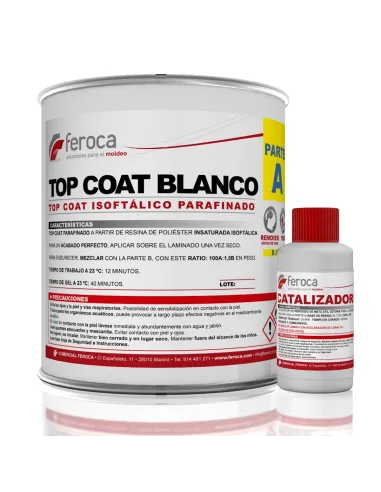
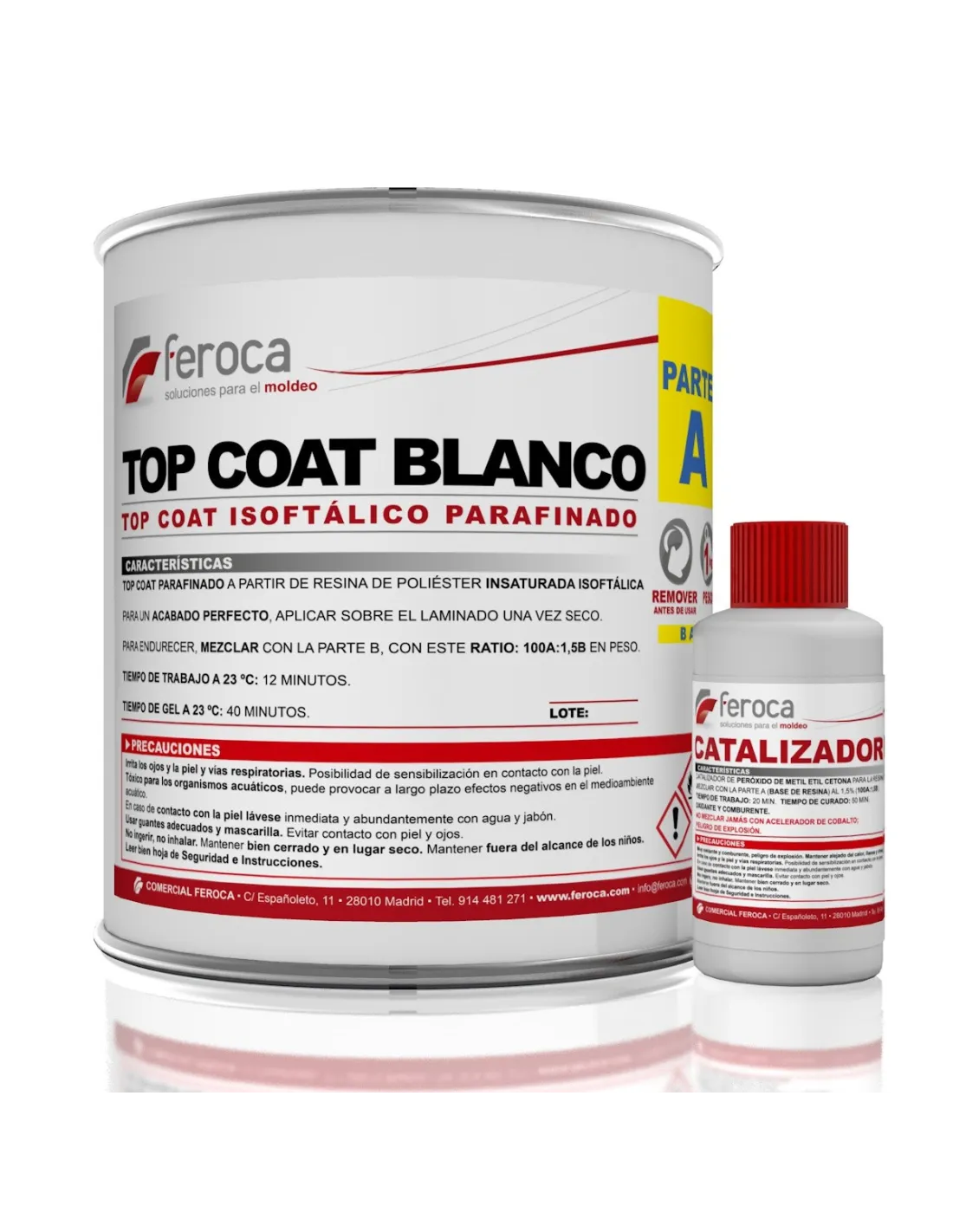
White Top Coat is an accelerated, paraffinated isophthalic polyester resin designed to be applied as a final finishing layer over already cured fibreglass laminates. Its paraffinated formulation guarantees complete surface cure in contact with air, leaving a solid, smooth surface ready for sanding or polishing. If you need a hard, durable white finish that's easy to apply, this is the straightforward choice.
Technical specifications
| Property | Value |
|---|
| Resin type | Isophthalic polyester |
| Formulation | Accelerated, paraffinated |
| Colour | White |
| Kit contents | 1 kg Top Coat + 25 g Catalizador F11 |
| Catalyst included | F11 (MEKP) |
| Application timing | Over dry, fully cured laminate |
| Application method | Soft-bristle brush or spray gun |
What it's used for
White Top Coat acts as a sealing and exterior finishing layer on fibreglass parts and polyester laminates. Being paraffinated, it cures completely on the surface (no tack), so it can be sanded, polished and painted without any additional treatments. It is the natural complement to any polyester laminate when the part requires a white, uniform exterior face.
- Final finish on parts laminated with fibreglass and polyester resin
- Sealing of the outer layer on boats, tanks and exterior elements
- Repair of deteriorated or porous polyester surfaces
- White base coat prior to painting on composite parts
- Surface protection on polyester panels and bodywork
- Finishing on automotive, marine and construction composite components
How to use it
- Prepare the laminate: make sure the polyester resin lamination has fully cured (minimum 1–1.5 h in a temperate environment, until the surface does not yield to the touch). If the laminate has any residues or contamination, clean it with a suitable solvent.
- Prepare the mix: stir White Top Coat thoroughly before opening (it is thixotropic and may have settled). Add Catalizador F11 at 1.5% by weight (15 g per kg of top coat). Mix thoroughly for at least 2 minutes.
- Apply the top coat: spread with a soft-bristle brush or spray gun in a generous, even layer over the entire surface. Work in a regular direction to avoid marks or bubbles.
- Curing time: under normal conditions (20–25 °C), the top coat gels in 20–40 minutes and hardens in 1–2 hours. At lower temperatures, curing slows down considerably.
- Second coat (optional): if greater thickness or coverage is needed, apply a second coat once the first has gelled but is still slightly tacky (green stage).
- Final finish: once the top coat has fully cured, sand with fine wet-and-dry paper (400–600 grit) to level the surface. You can then polish or paint according to the desired finish.
Warning: White Top Coat contains styrene and Catalizador F11 (MEKP) is an irritant organic peroxide. Always work in well-ventilated areas, wearing nitrile gloves and safety glasses. Avoid contact of undiluted catalyst with skin and eyes. Do not mix the catalyst directly with accelerators: always add the catalyst to the already-prepared resin. The reaction is exothermic; in large quantities it can generate significant heat.
Usage tips
Catalyst dosage according to temperature
The standard ratio for Catalizador F11 is 1.5% (15 g/kg). In summer or when ambient temperature exceeds 25 °C, you can reduce to 1% to allow more working time. In winter, with temperatures below 15 °C, increase to 2% to ensure proper curing. Never exceed 3% or go below 0.5%: above that the cure will be too fast and brittle; below it may not cure at all.
Application and optimum thickness
A single well-applied coat is usually sufficient for a uniform finish. Avoid applying overly thick layers in one go, as excess catalyst in mass can generate heat and cause cracking. If more thickness is needed, work in two moderate coats. For a very smooth finish, apply with a low-pressure spray gun; for hand application, use a natural-bristle brush without excessive drag marks.
Surface preparation and compatibility
Top coat adheres best to lightly abraded polyester or vinylester laminates. If applying over a demoulded part, make sure to remove any traces of release agent before applying the top coat, as wax contamination can prevent adhesion. If the laminate has Gel Coat Blanco as the inner mould face, the top coat always goes on the outer face (last layer of the part).
Frequently asked questions
What is the difference between a gel coat and a top coat?
The gel coat is applied first in the mould, before laminating, and forms the visible face of the part. The top coat, like this White Top Coat, is applied at the end, over the already cured laminate, as a finishing and exterior protection layer. The top coat is paraffinated to cure in contact with air; the gel coat generally is not.
How much catalyst do I need for 1 kg of top coat?
The kit already includes the 25 g of Catalizador F11 needed, which equates to 2.5% of the total kit weight. The recommended working dosage is between 1% and 2% by weight depending on temperature. The 25 g included gives you room to adjust according to workshop conditions.
Why does the top coat remain tacky after curing?
If the surface remains tacky it may be due to insufficient catalyst dosage, too low a temperature or high humidity. White Top Coat is paraffinated, which normally guarantees surface cure. Check that you have mixed the catalyst thoroughly and that the temperature is not below 15 °C. If the problem persists, apply a second re-catalysed coat.
Can the top coat be sanded and polished once cured?
Yes. After full cure, sand with fine wet-and-dry paper (400–600 grit) to level the surface. You can then polish with a polisher and polishing compound to achieve a glossy finish. White Top Coat accepts paint well afterwards if the surface is clean and lightly abraded.
Can I apply it outdoors or in damp areas?
Yes, the isophthalic base of White Top Coat gives it good resistance to water and weathering, making it suitable for marine applications, tanks or elements exposed to moisture. For continuous immersion areas (such as swimming pools), consider Top Coat Azul Piscinas, specifically formulated for that use.
How long before it can be sanded?
Under standard conditions (20–25 °C), the top coat is ready to sand in 2–4 hours. For full cure and maximum mechanical strength, it is advisable to wait 24 hours before sanding or subjecting the part to stress.
Is it compatible with all polyester laminates?
Yes. White Top Coat is compatible with orthophthalic, isophthalic and vinylester polyester resin laminates, such as those made with Ferpol 100 BSX15 DCPD. It is not suitable for application directly over epoxy surfaces without a specific intermediate primer.
Where can I find the product's technical data sheet?
The downloadable TECHNICAL DATA SHEET is available on the product page at feroca.com, under the "TECHNICAL DOCUMENTS" tab. There you will also find the safety data sheets for the top coat and the catalyst.