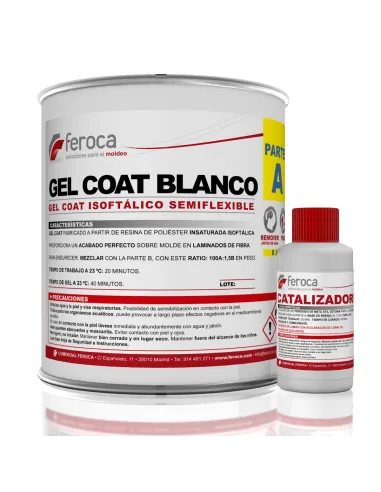
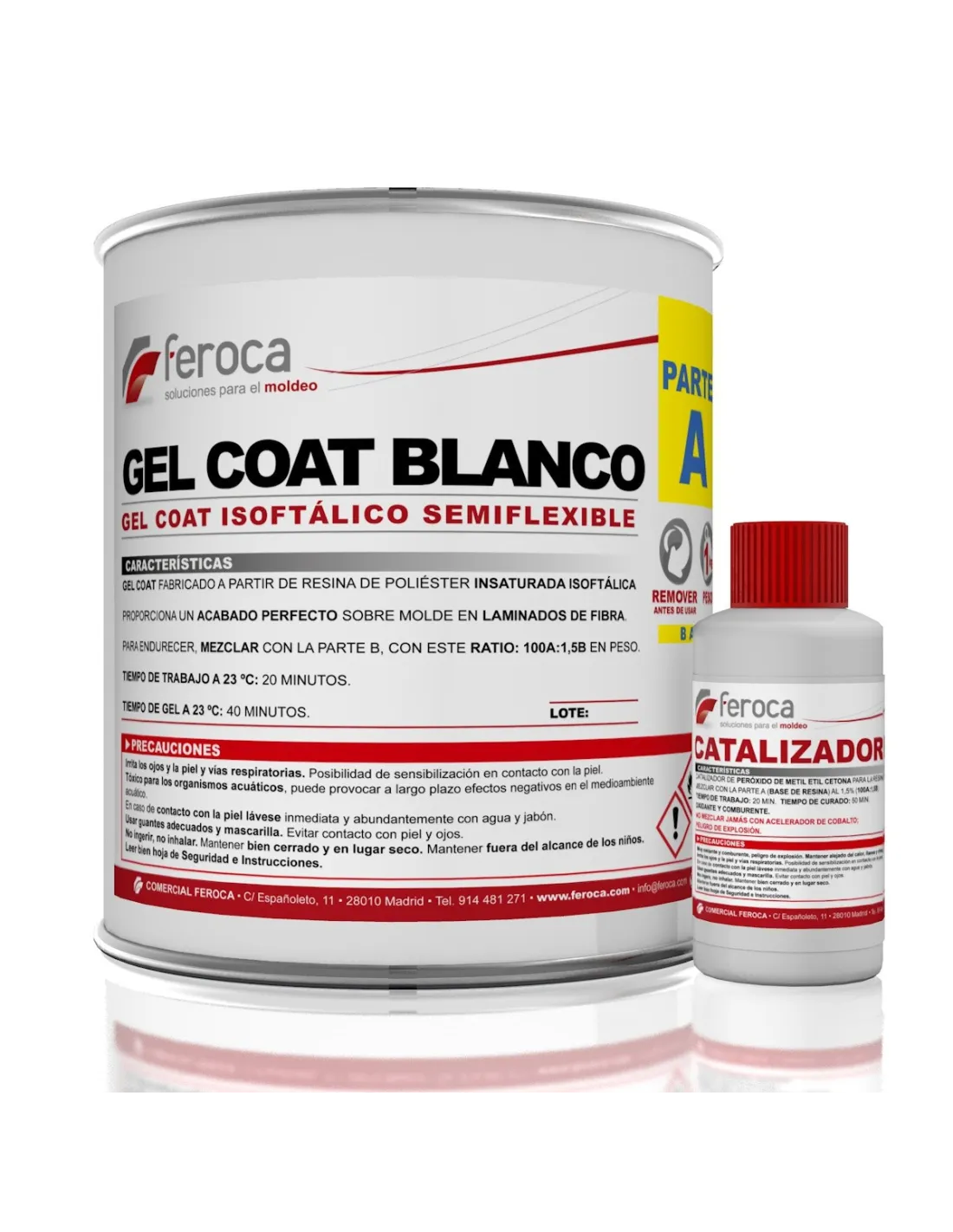
Feroca's White gel coat is a semi-flexible isophthalic accelerated gel coat, formulated to provide a high-quality surface finish on fibreglass laminates. Its isophthalic formulation gives it better chemical and weathering resistance than ortho-phthalic gel coats, making it the first layer seen and touched by those who will use the finished part. The kit includes 1 kg of gel coat and 25 g of Catalizador F11, everything you need to get started.
Technical specifications
| Parameter |
Value |
| Resin type |
Semi-flexible isophthalic |
| Status |
Accelerated (ready to catalyse) |
| Colour |
White |
| Kit contents |
1 kg gel coat + 25 g Catalizador F11 |
| Included catalyst |
F11 (methyl ethyl ketone peroxide) |
| Recommended catalyst ratio |
1.5 – 2% by weight |
| Application |
Brush or gel coat spray gun |
| Family |
Polyester gel coats and top coats |
What it is used for
White gel coat is applied as the outer surface layer on parts laminated with fibreglass and polyester resin. It is the first layer deposited onto the mould, so that once demoulded it sits on the exterior of the part, providing a smooth, compact and resistant finish. Its most common applications are:
- Manufacturing fibreglass parts with a white surface finish (body panels, covers, panels)
- Protection and decoration of laminates in marine and boat building applications
- Repair and restoration of damaged or deteriorated polyester surfaces
- Production of bathtubs, showers, washbasins and sanitary ware in polyester
- Decorative and display parts requiring a clean white finish
- Polyester moulds where the external surface needs to be protected
How to use it
- Prepare the mould: thoroughly clean the mould surface and apply several coats of Desmoldeante 34D or Maximum Mold Release Wax No. 8, allowing to dry and buffing between coats. Proper release agent application is critical to preserve the mould and achieve a perfect surface.
- Catalyse the gel coat: add Catalizador F11 at a ratio of 1.5 to 2% by weight (15–20 g per kg of gel coat). Stir for at least 2 minutes, making sure to scrape the bottom and sides of the container.
- Apply the first coat: spread the gel coat with a soft-bristle brush or a dedicated gel coat spray gun. The coat should be uniform, between 0.4 and 0.6 mm thick. Avoid build-up in corners.
- Apply the second coat (optional): if greater thickness or coverage is needed, apply a second coat as soon as the first has gelled but not fully cured (does not mark on touch but yields slightly). This typically occurs between 20 and 40 minutes depending on temperature.
- Wait for full gel: allow the gel coat to cure until it no longer marks with a finger before starting lamination. In a temperate workshop (20–22 °C), this point is reached in approximately 30–60 minutes.
- Laminate over the gel coat: apply the laminating resin (e.g. Ferpol 100 BSX15 DCPD) over the gelled gel coat and lay up the fibreglass layers. Use a metal de-airing roller to eliminate bubbles and consolidate the laminate.
- Demould: after the laminate has fully cured (minimum 4–6 hours under optimal conditions, ideally leave 24 h), demould carefully and inspect the surface finish.
Important notice — polyester resins: Catalizador F11 (MEKP) is an irritant and oxidising organic peroxide. Avoid contact with skin and eyes; wear nitrile gloves and safety goggles. Always work in a well-ventilated area. Do not heat the catalyst or mix it directly with cobalt accelerators without first dispersing them in the resin: a violent reaction may occur. Polyester resins generate exothermic heat during cure; in large masses, this heat can be significant.
Usage tips
Working temperature and gel time
Workshop temperature directly affects gel and cure times. Below 15 °C the cure slows considerably and the coat may remain under-polymerised. Above 30 °C gelling accelerates and can become difficult to control. The ideal range is 18–25 °C. If you need to adjust timing, slightly modify the catalyst percentage within the recommended range (1.5–2%).
Coat thickness and surface finish
Correct gel coat thickness is key: too thin and the fibre will "print through" to the surface; too thick and it may crack. Aim for a total of 0.4–0.6 mm, equivalent to one or two well-applied coats. When brushing, use uniform strokes and cross the direction of passes between coats. After demoulding, any minor imperfections can be levelled with fine wet-and-dry sandpaper and finished with polish.
Release agent use and mould maintenance
Never cut corners on mould preparation: apply at least 4–5 coats of Desmoldeante 34D on new moulds, and at least 2 coats for each subsequent pull. Poor release can tear the gel coat from the mould or scratch its surface, ruining both the part and the mould. Store gel coat in a cool place (10–20 °C), away from direct light and with the container tightly sealed; it has a limited shelf life once opened.
Frequently asked questions
What is the difference between a gel coat and a top coat?
The gel coat is applied directly onto the mould, before laminating, and becomes the outer layer of the part once demoulded. The top coat, on the other hand, is applied at the end, over the already-cured laminate, as a finishing layer that also seals the surface (polyester cures poorly when exposed to air without this seal). The White gel coat is intended for the first method; if you need the second option, see the Top Coat Blanco.
Can I apply gel coat directly onto an existing part to repair it?
Yes, gel coat can be used to repair damaged areas on existing polyester parts. Sand and clean the repair area thoroughly, apply the catalysed gel coat and cover with polyethylene film to prevent air contact (which would inhibit surface cure). After curing, remove the film, sand and polish.
How many coats of gel coat do I need to apply?
Generally one or two coats are enough to reach the optimum thickness of 0.4–0.6 mm. The second coat is applied once the first has gelled but not fully cured. Exceeding this thickness will not improve the finish and may cause micro-cracking during cure or in service.
Why is the gel coat surface still tacky after curing?
Polyester resins cure poorly when in contact with atmospheric oxygen, leaving a tacky surface layer. This is normal if the gel coat has been exposed to air. In standard use, this tacky layer is precisely what enables adhesion with the subsequent lamination. If the gel coat is used as a final layer (not typical), cover with polyethylene film during cure or use a top coat formulated to cure in air.
How long should I wait between the gel coat and lamination?
Wait until the gel coat has gelled: it no longer marks the finger on touch but yields slightly, like a firm jelly. Laminating too soon can displace or ruin the gel coat layer; waiting too long (gel coat fully cured and hard) reduces inter-layer adhesion. Under normal workshop conditions (20 °C), this point is reached between 30 and 60 minutes after application.
Which laminating resin is compatible with this gel coat?
It is fully compatible with polyester laminating resins such as Ferpol 100 BSX15 DCPD. Both products are polyester-based and bond perfectly to each other when gel times are respected.
Can the gel coat be pigmented to obtain a different colour?
White gel coat already has a factory white colour. If you need a different shade, you can add polyester-compatible pigments in small quantities (generally up to 5% by weight). For large orders with custom RAL colours, consult the Feroca team: minimum quantities and lead times apply.
How do I clean tools after using gel coat?
Clean brushes, rollers and containers immediately after use, before the gel coat hardens. Use acetone or polyester solvent. Once cured, gel coat cannot be dissolved and tools will be unusable.